


Today is a very exciting day here at Patterned By Design. We are featuring an essay by my friend Paul Alan. There will be no commentary, but still perhaps a PostScript or two.
I have no idea what this space will become across time, but I used part of his essay’s argument in my giant Minnesota / Civilization piece. I also interviewed him two days ago, yet to be released.
Paul Alan writes, but doesn’t have a desire to create his own space to post his own stuff, so obviously I couldn’t let a good piece of writing not get published.
Without further ado, Patterned By Design Presents: Paul Alan.
Fractal Morality and Universal Basic Institutions
In order to address the necessity of basic institutions for the moral order, I am laying out a synthesized ethic in order to assess questions related to individual and communal good. There are three motivating questions: 1) Why do we intuitively relate more to a local good over a distant good? 2) What is a good community? 3) What are the ethical consequences of an ontology that foregrounds fractal patterning? I will propose concepts of entities participating fractally. The definition of the Good follows naturally from those concepts. I will relate this notion of the Good with natural law, divine will and a virtue ethic. I will posit that communal participation is necessary for the good. I will explain it as a practical ethic for the individual by laying out Universal Basic Institutions.
Entities participate and are participated in fractally. I will define an entity as a set of processes that are autopoietic, maintaining self similarity across time. For an entity to participate in another entity, the lower entity engages in activities and processes that make up the higher entity. Information is shared bidirectionally, upwards and downwards. Stability of the lower entity enables greater complexity of the higher entity. This is fractal because one finds stable autopoietic entities that participate in higher entities at many levels arguably from subatomic particles to chemistry to biology to society to spirituality. Similar sets of rules governing organization, stability, adaptive systems and emergent layers of complexity are perceptible across many layers. While (obviously) not an exhaustive explanation of the order of being, it is sufficiently central to the order of being that it must be central to our conception of morality and practical ethics.
The lower entity in participating in the higher entity aligns with the will of the higher entity. The cells “are” the organism to the extent they are right ordered in the manner as to produce the will and function of the organism. Just the cell participates in tissue which participates in organs which participate in organisms, there are multiple thin layers of participation above individual humans. The participation is differentiated and complementary: not all cells participate in the same manner but together they sustain the tissue. A large corporation is a body made up of layers of divisions and teams. Entities regularly participate in multiple hierarchies in different manners. Participation is bidirectional, the body provides structure, purpose and access to resources for the members and the members participate in the body’s processes. Each individual entity is definitionally sustaining and stabilizing itself, but also acting within the process of the entity it participates in; this maintains an inherited telos (looking up) and necessary stewardship (looking down).
Acting in a way that undermines the entity/body you are participating in will destabilize that entity. Generally mature entities will have processes to first identify then correct or eliminate problematic elements. A few bad actors will weaken a system and several bad actors will destroy or usurp the purpose of an entity. Alignment with the role and purpose of the entity which you are participating is essential to the being of the body. In an informational sense (appropriate for that fractal level), there is some communication of the will of the entity and the participatory purpose of the participating elements. We should expect to see rules, codes and messaged intentions.Your human body pushes down instructions to your component part by way of the nervous system and hormones. Long lived stable entities have corrective processes internal to their body, however if too many processes fail, the entity will fail.
The primary duty for the existence of “all things” is alignment of the parts with the whole. I propose that “the good” is the recursive alignment up the hierarchy to the ultimate telos, that is God or the universal purpose. From the perspective of the moral agent there are three considerations: 1) Am I acting in alignment with the institutions and communities in which I am participating? 2) Are the institutions I am participating in aligned with higher order of institutions or cultures? 3) Am I being a steward of the entities that comprise me? If I am intentionally and diligently performing my duties within my institution, in alignment with the mission of that institution, this is moral. If I leverage my responsibilities for my own end, I embody corruption. I have some agency in the institutions and communities I choose to participate in. If an institution is itself is misaligned with the systems it is participating in, then aligning myself with the telos of that institution is immoral. Being an excellent accountant for the mafia is recursively misaligned and immoral. While it is not possible to fully understand and judge the alignment of the full chain, especially at higher levels like nation states, the responsibility is to use practical judgement and where reasonable align with institutions which you see as good.
A typical person’s direct participations are in family, work, worship community and neighborhood. A functioning neighborhood has neighbors that watch out for each other and generally care for common spaces. Participation with people dying of famine in Sudan is mediated by several layers of hierarchy to the point where my nation state or church hierarchy is neighbor to institutions within Sudan and is able to facilitate food. If my participations are well aligned, resources from my broader bounty will be shared with the people of Sudan. The individual or even local church need not attempt to adjudicate the order of goods in higher order, they must simply participate in communities they see aligned with the higher good and be a contributing participant within those communities. Leaders and councils within each layer of the hierarchy make the same determination for their community with respect to higher order institutions, markets and cultures.
This morality is perhaps an elaboration on Jesus’ command to love God and neighbor. Loving God is the recursive orientation upwards: we align our will and participation to the highest order of good we perceive. Love of God is oriented upwards but necessarily mediated. This is inseparable from loving our neighbor, those who we directly participate with in life. This extends beyond racial and social class to all those in need along life’s path. This is the preservation of individuals in our community, but also the alignment towards communal abundance to provide for the poor and strangers. Implicit in the framework is an alignment with a divine will or natural law, with the helpful addition of mediation of the interpretation of this ultimate good by the normal means of communal participation.
The framework maintains some aspects of a virtue ethic in that a personal is called to live out excellence in roles they take on. If I participate in the family as a father, I take on the virtues of excellence in fatherhood towards the telos of the family. In my work role as an economist, I take on the virtues of an economist and in doing so I serve the needs of the work institution. The role of the teacher is distinct from the role of the soldier, yet excellence in both can be well aligned with a higher purpose of security and prosperity for a nation. The behaviors that are virtuous for the soldier are abhorrent for the teacher, and vice versa. A fractal mortality incorporates this concept and unifies by recognizing that there are a sequence of hierarchies that can eventually converge, and the teacher and soldier play different roles towards the same telos at the level of a nation.
If one believes God is the source of all being, sustaining all being, then the notion of Good and the notion of Being collapse into one. That is to say, each layer of good is aligned to sustain being, both locally and recursively up the levels. The ultimate good can be the source of being itself, an autopoietic whole where each recursive strand of good sustains its own being and the being of all. This is not to say the systems are not without suffering and kenosis; the parts often sacrifice for the whole and systems of enforcement for preservation are essential for a sustained whole. If individual entities at any layer prioritize their own will and excess, you quickly have cancer, misers, hedonism and parasitic institutions. Therefore, a functional system must continually orient entities upwards and correct self-indulgence.
Inherent in this morality is the essential role institutions play in the moral life of the individual. Good is only achieved in proper alignment upwards. The relationship with direct institutions you participate in is the tangible enactment of your relationship with “the Good”, God and/or humanity generally. I will cover five facets of institutional participation, Universal Basic Institutions. These facets are not independent of each other, but they are distinct aspects of the person.
The biological, family.
Innate in our humanity is that we are a species of biological creatures that is propagating and selecting biological traits. Family evolved in humans in a real biological manner as a series of processes to self-sustain the biological aspects of our humanity. The functional family loves and supports each other for the raising of children. Individuals see themselves biologically in other members, so there is a biological communion. The telos of the family is better children. Individuals mode of participation in the family varies wildly based on time of life from mothering infants to supporting adult children to seeking a suitable spouse. The family in turn lives within the Universal Basic Institutions that follow. Individuals participate in economics and culture on behalf of or in participation with the family.The biological component may play a role in ethnic aspects to some cultural fractals, but even in a post ethnic era communities want robust families as a source of economic and cultural stability. A good family nourishes its members and supports the communities in which they participate.
The economic, work and market.
The material needs and abundance are necessary forsurvival and growth of an individual, family and culture. Economic participation puts bread on the table, most often first by engaging in a paid productivity activity, then exchanging payment for bread in some sort of market. Many economic entities are layered and complex, but the individual generally enters as a participant in a basic team with a specific set of tasks. The worker does tasks and is compensated in some manner as to meet physical needs. A good corporation sustains its workers and aligns with the rules and expectations for the market in which it participates in. Work is fundamentally participatory because at the level of basic institution (within the complex corporate structure), there is a clear purpose and the basic institution generally has agency in how the purpose is achieved.
The physical, the gymnasium.
Humans are necessarily physical and the body requires attention and training. Sports, martial arts and training build physical strength, physical discipline and communal participation. A gym or sports club participates in a culture that can build up or tear down a person and nation. A culture of fitness, discipline and comradery will enable a nation in both self control and the common defense. A good gym sustains and grows its participants building community within a culture of physical well-being and mutual support.
The intellectual, the forum.
While we have few literal forums we have libraries, schools, theatres, music halls, art studios and local government. Just as humans are necessarily biological and material, they are rational and intellectual beings. Institutions where the intellect participates and grows are essential to the person. Just as economic institutions take on a variety of forms, the intellectual institutions range from romantic to pragmatic. While spectating is one form of participation, full participation in learning, art and music enriches the body of understanding building up that community. A good intellectual forum encourages interactions between participants that grows the intellects of individuals and serves the needs of the broader community. Schools in particular must care for its participants: students, teachers and families while following the needs of the society in which it participates. A school can be self-serving either to the whims of the students or preferences of the teachers, undermining the value of the school to the broader culture. I am placing local government in the forum as an ideal of political interaction where governance is grounded in rational discourse of members.
The spiritual, worship.
Worship entails humility and looking up. In order to enact the fractal morality, one must “look up” the recursive layer of the fractal and seek that which is good: layered purpose which sustains being. Purpose or meaning requires looking up and seeking to participate in the good you see. All longing gazes upward are essentially worship. Worship is communal in that it brings together many individuals and families and orients them together. The event of worship is not top down endowments to the participants, rather it is generated by the participants directed towards that which is higher. Good worship aligns with truth. Bad worship is incredibly corrupting in that it can disorient an individual’s judgement in other facets: intellectual, biological, physical and economic. Whereas good worship aligns intellect, economics, biological and physical well-being. Worship communities generally have some level of fractal organization that shares information across hierarchies; as liturgies and wisdom may propagate down uniting denominations across contexts, cultures and tim, in turn all within the fractal organization look up at the same truth.
Why are these rightfully called Universal Basic Institutions? I will walk through the three elements of the phrase, then tie it to the identified institutions. While the name is a response to Universal Basic Income, each of these terms remains meaningful.
Institution.
Institutions are entities, therefore autopoietic processes participated in by human persons according to self sustaining forms. Within an institution people interact within specific roles, following specific forms in order to sustain the institution and fulfill the needs of that institution. The farmers market will have a leadership committee that organizes the market, provides services to vendors, the vendors provide the wares, the customers purchase the goods and the old-timey folk musician provides atmosphere and levity. A good farmers market requires all of these participants to come together. There are forms and rituals to the timing, the casual but polite etiquette, and the music. The supermarket is also an institution serving the same function, but with different roles and different forms/rituals. Where the farmers market is aligned upward with a cultural spirit of local abundance and regional farming institutions, the local branch of the supermarket is aligned with its corporate office. Institutions are moral entities where we should be able to consider whether their actions and participations are good.
There are teams and communities that are not institutional because they do not have forms that are intended to sustain the group. An Homeowners Association, although much maligned, is the institutional instantiation of the neighborhood, providing roles, processes and forms for neighborhood interactions. It is near impossible to maintain a community park or pool without institutional forms to maintain the commons. A neighborhood without institutions would struggle to build and maintain such things and would likely create or work with an institution if it wanted a neighborhood park.
Why institutions, not communities? The institution is the vessel for the community. A good institution, one properly aligned with institutions and cultures, will be a steward for its participants creating community. The shapes of the community differ with the forms of the institutions, but a sustained community requires the forms and purpose provided by the institution. An institution without community acts against the health of its parts and is a corruption. A community without an institution is fragile and will not sustain.
The family is an institution because of the very specific biological and cultural forms for the purpose of a sustained social structure extending across generations. Marriage is a clear form with specific words and promises. Motherhood is a specific form dictated by biology, to a lesser extent the role of paternal uncle has a father adjacent quality.
Universal.
Participation in these communal groups are universal in that they are common to our humanity along different facets of that humanity. All of us are biological and have a family of origin. We are necessarily economic requiring material goods which are universally acquired through networks of people and institutions. Humans are universally corporal and have a relationship with our physical bodies. Communal physical fitness is the most functional strategy for maintaining health. The intellectual builds on the faculties of reason that define mankind. Finally, worship is a universal call to the Good.
Basic.
These institutions are basic in two senses: they cannot be broken down into further more basic institutions and they are in support of the foundation of our humanity. Teams that operate on fully connected networks (all members related with all members) are limited to a dozen. Beyond that relationships are mediated by structure. A basic institution is the necessary and sufficient structure that can maintain and organize teams that cannot be further divided into component structure with those properties. A family is a basic institution in that it provides structure for scale (parental leadership, physical structure, legal responsibilities); these can be scaled intergenerationally but the parental leadership is essential and seeds the institution. Businesses and government are often conglomerations, complex, not basic institutions but if you apply a principle of subsidiarity you can find the basic institutions within. A basic economic institution maintains teams and structures that encapsulate provision of a good or service. An accounting department may keep the books (a service) for the corporation they are part of, but the leadership, standards, processes and personnel are hired. In a boring sense, a store, a library, a gym are the basic institutions: Subway as local sandwich shop as opposed to global brand, church as neighborhood place of worship as opposed to denomination.
Without institutional support for the raising children, meeting material needs, physical health, intellectual growth and spiritual orientation we are greatly diminished as persons and a people. All of these things are implicit in our understanding of humanity. Transcendence beyond individuals is basic and should be the expectation.
Why Universal Basic Institutions matter
If the good is mediated by our participation in institutions, the nature of the institutions in which we participate is deeply meaningful. While we may look up and through the fractal layer to the ultimate Good, we interact with the basic institutions in which our lives are embedded. Participation in a good institution is deeply good for the individual aligning themselves with that institution. Lackluster and weak participation in institutions will lead to morally vacuous individuals, even if the institutions they are attached to are good. Active participation in an evil or corrupt institution is itself corrupt.
One may object, “I can be a good person without institutions”. Assume such a person has great moral vision, knowing the good. First, such a person would see a multiplicity of wrongs to right and goods to participate in, and would be overwhelmed by their relatively meager ability to address what they see. Second, they would see institutions that are good as good. If they refuse the participation in good institutions, they refuse both the capacity to extend their moral self creating capacity to address more of the moral good and they turn their back on entities they know to be good. If one accepts that institutions are universal and natural to our humanity, then such institutions are not exceptional sources of good rather they are foundation. If something is seen as good, is foundational to our humanity and extends our capacity to do/be good, intentionally avoiding such a thing would be evil. Furthermore, if we observed no good institutions accessible to us, there would be a moral obligation to plant an institution that is good.
If one sees the validity of this ethical synthesis, it is then useful to understand the institutions that are typical for human flourishing and point towards the Good. In practice, an individual can take inventory of the institutions they participate in and the quality of their participation. A conceptualization of the Universal Basic Institutions facilitates the individual’s self assessment of their alignment to the Good through participation in these institutions.
From the perspective of a government or corporation one can look down at basic institutions within your complex organization and ask if they align well upwards with the telos of the organization, and if they are good stewards of those that participate in them. Governments should acknowledge that the quality of the Universal Basic Institutions is important both for the functioning of a good society (and government), and for the well being of the citizens that participate within these organizations. Government policy around family and labor directly impact the forms of the familial institution and economic institutions. Schools and universities are directly under the purview of the government or the church. Both the state and large corporations should address the question: “What are the basic institutions in which my citizens participate? Are these institutions well formed and healthy.”
The health and stability of these basic institutions are both top down and bottom up responsibilities. Individual participants are responsible for vibrantly enacting the institution. The higher institutions, cultures and entities are responsible for providing forms, support and protections that allow basic institutions to flourish. Moreover, these universal basic institutions, like any entity, can be corrupt, misaligned and evil. It is both the participants obligation to not participate in institutions that are not good, although this is not always knowable or feasible, and it is the higher institutions obligation to prune and reform corrupted institutions.
Universal Basic Institutions in response to the moment and Universal Basic Income
If individual utility is foundational to one’s view of the good, then income is a proper response to allow that individual to maximize that utility as they see fit. If the good is bound in a universal participation in an hierarchy of ascending telos, then what individuals need most are healthy institutions through which they can participate with each other communally towards the Good. If the danger posed by AI is loss of income, then Universal Basic Income is a response. If the danger posed by AI is loss of economic institutions where the worker finds purpose along with degradation of many other institutions through digital replacement, then income will not replace what is lost. Emphasis on Universal Basic Institutions is counterpoint in this emerging moment emphasizing the communal and institutional costs of digitalization and AI.
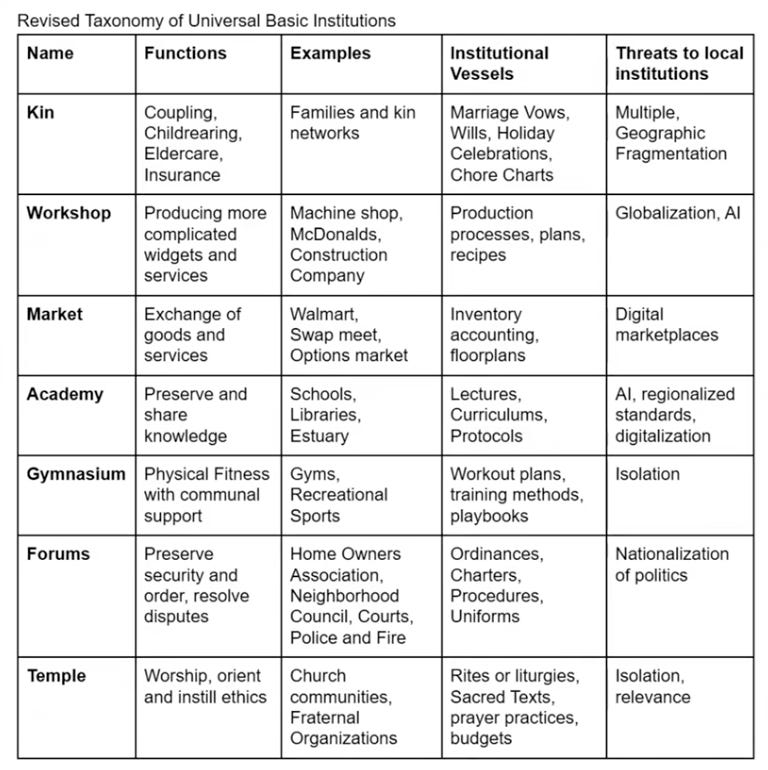
Universal Basic Institutions, what is the call to action?
Universal Basic Institutions arise from an ethical proposal that humans necessarily participate in institutions, therefore in doing so they should participate in good institutions and align with the telos of those institutions. These institutions have forms, roles and liturgies that allow them to exist as vessels of purpose and community extending beyond specific human individuals. A basic institution are those institutional forms which we are participating in directly: family, worship community, workplace, school, gym or market. Universal institutions necessarily reflect universal elements of our humanity and how we gather communally. The Universal Basic Institution may inherit forms from the above (law, culture, nature and God) but they integrate into the lives of the many in direct, often mundane, manner. They are proximal locations of formation. Complimenting this, Universal Basic Institution mediates a participation in the Good, providing the individual with a practical onramp to a telos extending upwards toward the ultimate.
Assume you accept this concept of Universal Basic Institutions as reflecting something real and important about the world. What then? Why does this matter?
Introspection.
The primary purpose of this ethical framing is to provide an abstraction through which one can view our ordinary participations. If the institutions we participate in mediate purpose and good, it is best to put names to them and be active agents in that participation. The institutions you are participating in will form you even as you form them. Awareness that you and others are being formed by institutional participation enhances your moral agency.
Participate intentionally.
If you start to view the institutions you participate in as vehicles for good (or corruption), the manner in which you participate in them should change. First, understand the telos of the basic institutions where you are invested. If you see it as good, align your actions within the institution with the purpose of the institution. If you are a banker, serve your community through responsible lending. If you are a baker, bless your customers with nourishing beautiful sustenance. If you teach, pass on the communal knowledge that will ground and enable our youth. Sometimes this is showing up at church, praying, singing along and building relationships. Second, understand the liturgies and forms of your institution. Sense the “why” you do things, the efficiencies and intentional redundancies. When proper, work to refine the liturgies towards the telos, alternatively learn the history behind an odd behavior. Third, respect the roles, especially the complicated ones. There are often intentional tensions serving an important function within an institution acting as opponent processing.
Revitalize weakening institutions.
If you see an institution which serves a purpose or could serve a purpose in this evolving moment, intentionally build up that institution. Don’t overextend, but extend yourself. Be a sacrifice to secure the communal vessel. Weakened institutions provide a unique capacity for renewal for emerging purpose. A vibrant and mature institution is often near its capacity and must maintain what it has. A weakened institution often has useful forms (legal, physical and organizational) which can be revitalized by a new community.
Discern corrupted institutions.
Part of the ethic is that institutions can be corrupt and corrupted. This can be cancer from below or participation in a higher order of corruption. If you find yourself in a church, family, business or school which plagued with a corruption from within or above consider the following: 1) Determine if you are in a position to reform the corruption. Your role may be to fight corruptions, therefore execute against that corruption as is proper. 2) Look for a suitable exit. Do not rush to leave, but carefully and intentionally prepare a path out of the institution into a situation that is better aligned with the Good. 3) Sometimes the right choice is to suffer through the corruptions and evil, enduring in hope of salvation. Often corruption is its own demise, so we practice fortitude in enduring the suffering of the corruption for the moment prepared to rebuild on the other side.
Build purposeful liturgies.
If there are no institutions filling a communal need, begin by bring people together in an intentional liturgy. The liturgy must have a telos and it must have a form. Perhaps the telos is security for our children by coming to know and trust our neighbors and the liturgy is brats and hamburgers on the grill. Perhaps the purpose is cheaper local remodeling for elderly neighbors and training for high school boys in the trade, and the form is a small nonprofit hands-on training program. While often we jump to building new, there is wisdom to reform existing institutions as they contain the wisdom of practice and established relationships.
Working muscles, building habits.
There may come a time when the role of institutions will be forefronted and we will need to repurpose existing institutions for an emerging crisis. Understanding what the institutions are and how they operate should place us in a privileged place when we need to intentionally configure those institutions in an emerging environment. The exercise we do now adds to the muscle making us stronger for when a heavy lift is needed.
As with any idea, this is to be played with and refined. The thoughts here are a starting place on a call to actions. Others will improve this call. Some may have a specific calling to one specific aspect or institution. Others will have narratives that clarify the concepts. All of this can serve the good.
On Institutions and Agency
Three things are simultaneously true:
1) Institutions have their own agency. The processes shape direction that are in services of the institutional entity and not any one human within the institutional system.
2) Individual agency constitutes institutions and often enhance the agency of the institution. The menu of feasible actions of the institution can be expanded by roles within the institution, and individual humans are taking meaningful actions within the institution.
3) Institutions constrain and form agency. By participating within an institution you take on the limiting roles within that institution and sacrifice alternative actions and participations. The individual human is formed along many dimensions (intellectually, physically, emotionally, socially and perhaps spiritually) by their participations within the institution.If you are a high agency individual, an independent and introspective person, then the first and third points are a struggle and the second is an invitation. If you’re a lower agency individual who seeks formation the first and third points are stabilizing and the second point can be mostly ignored from their perspective. In this way you can have an intellectual and a simple person finding different manners of support by their differentiated roles within the same institutions.
Extended discussion on handling corrupted institutions
To flesh out the most difficult point in the call to action, I will define corruption within the ethical framework, then sketch 3 types of responses and three responses to corruption. This will give nine different areas where I will provide brief commentary.
Let us differentiate corruption from sin in that sin is our own failings to do good and corruption is our experience of the sins of others. Within the hierarchical ethic, the sin can belong to the layer of the individual, the basic institution or higher order institutions and entities. The willing participation in the corruption/sin of an institution is itself a sin of the participant. When we become aware that we are in a situation where there is corruption within our institution, what is the moral act?
I propose three possibilities: reform the corruption, exit the participation or endure the suffering of passive resistance. The best course of action is deeply situational, but in order to delve into potential situations I will explore three types of corruption. These corruptions are shadows of the three ethical principles laid out in the fractal ethic:
First, is the corruption of stewardship: the body is not caring for its constituent members. The humans within an institution receive from the institution material, physical, intellectual or spiritual sustenance as is proper to the nature of the institution. For example the family provides food for the children, the workshop provides remuneration to workers and the temple provides spiritual direction. If these are not provided adequately, the body starves and dies. Similarly, the institution provides basic order and security for those within the body. Failure to provide order and security to engage in the activities of the institution, undermines the institution.
Second, the telos of the institution is not upwardly aligned with the institutions in which it is participating. This could be a congregation in a religious denomination which is acting to undermine that denomination. A business may be swindling clients that it is contracted to provide service. The institution’s telos should be aligned with the institutions and cultures it is participating in, and not behaving in a parasitic or extractive manner. Inevitably this will end badly for the institution as it is either pruned by a higher institution or the parasite kills the host, but both outcomes can be slow and painful.
Third, the institution is aligned with higher institutions, but it inherits a corrupting telos from the higher institution or entity. Here your congregation is aligned with their denomination, but that denomination may be a parasitic cult. A business you work for may be aligned to serve a tyrannical military. These things happen, but now your institution should be asking the hard questions on ethical action in the situation on your behalf. How your institution is handling the higher corruption you perceive may inform your action within your institution.
Reform.
The highest option within an institution is to shape the institution away from corruption towards the good. The ability to do this is heavily dependent on your role within the organization. If you are in a leadership or advisory role, it is your ethical responsibility to take the posture of reform by the nature of your role. If your role does not give you access to drive institutional change, reform may not be a realistic option. Reform that weakens the body could be counterproductive for the good. Reform comes from a place of both knowledge and humility born from intimate familiarity of the good within the specific institution.
Reform of neglected stewardship.
This is perhaps the most accessible reform. If there is a process which has broken down or could be enhanced to address lack of stewardship, one should restore or enhance the process. This can often be done without holding a leadership role, simply by stepping in and correcting the problem at an operational level. As a leader, the reform involves understanding and executing changes to meet the need. If an issue in your church is lack of teaching, volunteer to lead a catechism class. If a business suffers from chaotic meetings with tangents and bickering, prune the meetings down and establish expectations for decorum.
Reform of misaligned telos.
If the institution is not aligned with the telos of the institutions it is participating in, reform almost certainly must come from leaders and their advisors. One can name the issue and act within your role to act with integrity, but you cannot change activities and processes where you are not a credible leader. Often there are formal processes to change organizational objectives which should be leveraged to realign the telos of the organization.
Reform of participation in higher corruption.
The reform here can be simply naming the corruption, however it is incumbent on the leadership of the institution to understand inherited corruptions and to take a posture. Most participants in an institution will likely be shielded from these sorts of considerations.
Exit.
The decision to exit heavily depends on whether one can find a location to nourish you when you exit. This decision cannot be taken lightly and requires preparation and discernment. By extracting yourself from an institution, you can damage that institution and relationships associated with that institution. Depending on the nature of the situation, the higher good may be to preserve what is good in the institution by staying and enduring.
Exiting neglected stewardship.
If an institution is unable to provide for the needs of those relying on it AND another institution can fill that role, exit may be an act of self preservation. Restoration of stewardship for the institution is clearly a better path, but if that is not possible exit to a better situation is appropriate.
Exiting from misaligned telos.
Here the threat is not immediately to yourself but rather to the higher institution. If reformation is not feasible and you can find an institution that can substitute for this institution in your life (a new job or congregation),and voting with your feet can be a good. In many cases exit is necessary to avoid culpability before the institution is called to account. Often there are parallel basic institutions where you can find shelter. Again discernment is necessary because minor corruptions are everywhere, and you don’t want to abandon an otherwise good institution over a minor corruption.
Exiting from participation in a higher corruption.
This is much like the previous situation, however there are times where it is very difficult to escape a higher level institution or a social sin. The higher a corruption is up the chain of participation, the more difficult it is to escape and enduring may be the only option.
Enduring.
As Paul says in Romans, suffering builds endurance, endurance builds character, character brings hope. Often it is the case that we suffer and endure the corruption of the institution while avoiding direct participation in the sin. This often places you in the margins of the institution, avoiding specific work, not engaging in problematic liturgies and not saying the expected words. You can become an outcast in the institution or cast out of the institution by attempting to avoid and endure the corruption.
Enduring neglected stewardship.
Here the suffering is most direct. Bad stewardship means enduring lack of needed resources or a disordered environment with higher person risks. In the situation of work or family, leaving may not be a good long-term option and reform is slow so in the meantime you tolerate the petty neglect or chaos of the environment.
Enduring misaligned telos.
Here the lack of participation in the corrupting activities will set you apart and make you a target for folks trying to prune towards the corruption. Taking this road with a good conscience causes one to suffer through both isolation and sorrow. The knowledge of proximal wickedness is a suffering that wears on the conscious. The danger is that even passive engagement on the corruption can negatively influence your character. Pragmatically, many corruptions will be healed from above and below, and there is virtue in remaining to be that agent of healing.
Enduring participation from a higher corruption.
It is plausible that the issues with higher corruption are widespread. In these situations exit and reform are not clear options, and one can only endure the suffering and grow in character. Within the institution you can attempt to acknowledge the corruption and steer your basic institution towards a suffering.
Each of these responses will become more real but also more nuanced in the specific situations where people are struggling within institutions. I hope this provides some of the contours of the types of corruption we see in the world and how one can respond.
/. /\. /\/. /\/\. /\/\|. /\/\||. /\/\||\. /\/\||\..
/. /\. /\/. /\/\. /\/\|. /\/\||. /\/\||\. /\/\||\..
/. /\. /\/. /\/\. /\/\|. /\/\||. /\/\||\. /\/\||\..
Ta ta for now!
Post.Script
I love Paul Alan’s writing, specifically his meticulous thought processes, and am thrilled that he was cool with hosting a piece here! Thank you P.A.!
I am convinced God has a sense of humor and that it is of the grey variety. I recently announced that I would be posting weekly and not only that, but that I would be posting twice weekly.
Perhaps you didn’t notice, and it’s honestly better if you didn’t, but I didn’t post a piece of writing last week. And this week I’m posting someone else’s writing, which is quite a sneaky way of “not posting” two weeks in a row.
My Parish discovered that I come from the Great Wild West of Megachurch Land and have creative skills that can be of service. Specifically, film skills. I’ve built out my iPhone 15 into a rig and am now relearning ISO and shutter speed via the Black Magic app to capture RAW footage.
I was never very good at film. I am good with story and film was just a way to get paid to tell stories.
When I was working at the megachurch, I “quit” the film role due to arguments with the C-Suite and got reassigned to build out a blend of infrastructure, philosophy and theology to serve our local cities that could be applied across multiple sites. This, unsurprisingly, resulted in far more arguments than when I was just a storyteller. I ended up “quitting” that role, only to fail upwards, for a second time, into becoming the Communications Director.
There, that should be a satisfying enough lore drop for the archivists. So soon I’ll be back holding a camera and capturing stories on the behalf of the Body of Christ.
And of course the short essay I intended to write about blessing based on an email I got from a monk has turned into a two millennia bird’s eye view on the audacious act of translating the Bible from one language into another.
Meta.Script
My main use of LLM’s is as a superior google, which they are. Also, I haven’t looked, but is there any Internet search nowadays that hasn’t incorporated AI? I’m not sure if there’s an alternative option for searching the Internet.
So as I was using Claude to bring me information on Jerome and Wycliffe, Claude decided to write a sermon. Hopefully by next week I’ll be finished and I’ll get to share my thoughts on translation and then in a separate post: Claude’s translation of my translation of what translation is.
There’s something in Claude’s sermon that struck me. But we’ll get to that on a later date.
And speaking of weird LLM things, there’s this from yesterday:
End.Script
My opinion on what technology is and what Artificial Intelligence is becoming changes on a near weekly basis. After my recent, soon to be released, conversation with Ross Byrd, I’m 85% convinced that in much the same way you can beat a sword into a plowshare, you can sing to silicon.
May the grace of King Yeshua, the anointed one, and the love of Hashem, and the fellowship of the Holy Spirit, be with us all evermore. Amen.